
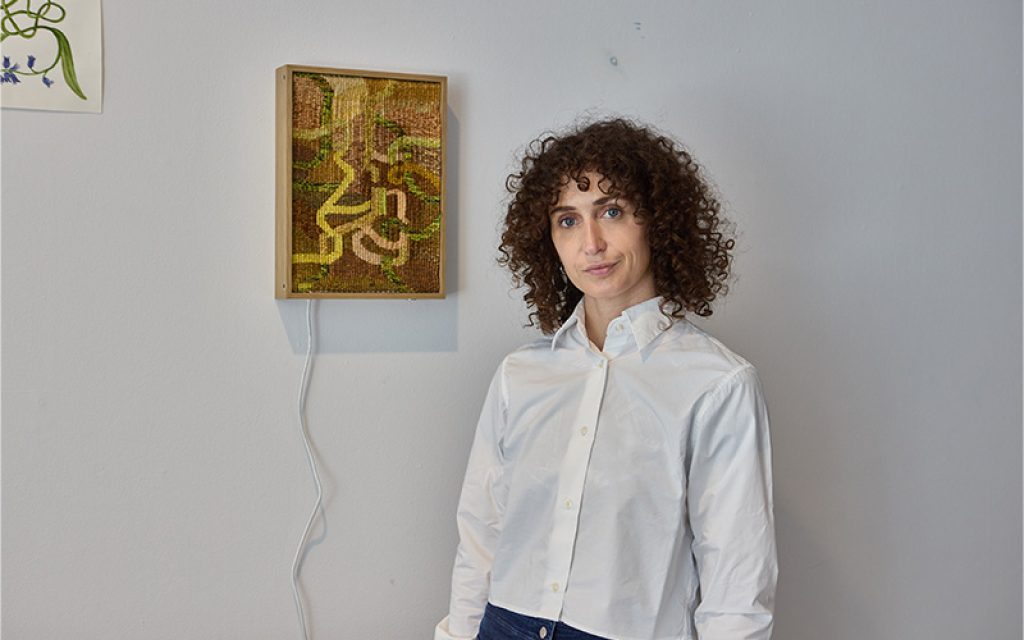
As part of Delfina Foundation’s spring 2026 thematic season, Making and Materiality, artist Chloe Bensahel developed new research into invasive plant species, botanical symbolism and the material histories of weaving.
In conversation, Bensahel and curator, lecturer, and artist Marleen Boschen trace the entangled histories of plants, people, and materials, reflecting on migration, craft, and the ways textiles can reshape our understanding of belonging.
Marleen Boschen: During your residency at Delfina Foundation you’ve been researching groups of plants that are biologically classified as ‘invasive’, which refers to species that have been introduced and are causing ecological or economic damage to ecosystems. You followed specific invasive species through research at Kew Gardens, the Royal Horticultural Society library and the British Library. What drew you to working with these plants and the idea of invasiveness, and what were you looking for in these collections and archives?
Chloe Bensahel: Before coming to Delfina Foundation, I had done a body of work with invasive plant species. It was actually by accident. I was looking for a paper maker in France to make paper that could be adapted to making yarn, because I was learning to make paper yarn while living in Japan. I found Benoit Dudognon, a paper maker who was working with the same material used to make traditional Japanese paper: the Kozo plant (Broussonetia papyrifera), named after the French botanist who discovered it. It was classified as an invasive plant in the south of France.
I started working with this material and realized it came from a foreign plant that had planted roots on French soil. I felt a weird kinship that developed with the material. It opened the door for me to weaving with materials that were ‘non-native’, or exogenous, so to speak.
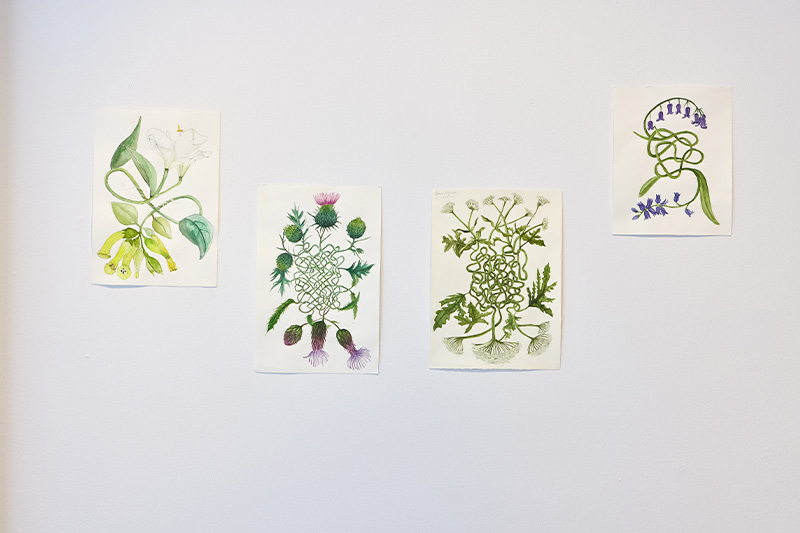
I started with a rather wide methodology, going through catalogues of invasive plants, and initially sorting them by origin (North Africa, France, USA), where they were, and where they had passed through. These places are connected to my family history. I started choosing plants, creating new hybrids as botanical drawings, and noticed that some looked a lot like plants I had seen in the countryside. Some invasive plants mirror local plants, which opened up a discussion around whether plants that become integrated or manage to survive might be those that resemble the local flora.
MB: I find there are parallels in how certain plants and animals are declared as ‘invasive’, and the othering of human migrants in current conversations around migration: questions of who is allowed to belong to a place and who isn’t. Your reference to mirroring is interesting here, and in the botanical drawings you’ve been developing you’re actively creating mirror pairings between native and invasive species. What happens for you through the process of botanical drawing, as a practice of attunement and observation?
CB: Before coming to Delfina, I read David Abram’s “The Spell of the Sensuous”, which retraces the origins of language in pictograms, and the transition from these (often referencing the landscape) to phonic Latin characters. Much of my previous work begins with language, so creating a visual language with plants felt like returning to the ‘roots’ of text, for lack of a better term.
I was looking for a way of connecting the native to the invasive, and while meeting with Amani Mitha, the Residency and Programme Manager at Delfina Foundation, she pointed out that the research was mirroring across different mediums: from textile to drawing. Mirroring then became a conscious decision in the depiction of these plants; they almost become hieroglyphs or characters.
There are cousins of plants that exist in different places; the world’s flora is interconnected. But somehow we’ve still managed to create these separations according to the weird maps that humans have designed.
MB: Ecosystems have constantly been reshaped by the ways people have moved plants. At the same time, plants have their own capacity for movement through seed dispersal, so ecosystems have always been shifting and evolving.
CB: This research has also opened up a much larger subject for me. I’m also reconsidering, and reimagining the movements of traditional fibres that I use when I make textiles. I did brief research into linen, for example, which in France is seen as a local plant. But actually linen was brought from Western Asia and Egypt, it settled and enjoyed the Northern European climate, which I found interesting: do native plants even exist anymore? The same question that you have in forestry: do original forests really exist any more?
MB: It’s an interesting question, where, in time, is the ‘native’ plant located. If a plant is thriving in a new place, what does that mean for the plant, for us, for the surrounding ecosystem? In Botany of Empire Banu Subramanian talks about Kudzu and the South of the United States. The plant was brought there and promoted quite aggressively as cattle fodder. It was thriving more than it had in Japan, which is where it had been brought from. In the long run, this is causing a lot of problems because it completely smothers the surrounding plants.
CB: What is the real issue, is it that humans feel like they’re not in control anymore? Is it that if we let the arrival of these plants slide, as humans, does that mean that nature will take over and put us in danger? But then, if these plants were actually responding to climate change and creating new ecosystems, shouldn’t we welcome that as well?
MB: I wanted to come back to what you were saying about the fibres you were making from invasive plants and working into your tapestries. What does that look and feel like as a material process?
CB: I work with the papermaker who harvests the plant, but only the external layer of the stem, which is then soaked in water and other ingredients. This is then turned into Japanese-style paper. This material is compatible with weaving since it contains long fibres, and, as paper, I slice it into strips, before twisting it into yarn with traditional drop spindles that are used for wool.
Then that gets woven into tapestries. I work a lot with motifs of interconnectedness and entanglements in different ways. I’m inspired by medieval tapestries that use these forms to express relationships within the natural world and the ways cultures become intertwined.
I love creating new materials, but I was also disappointed that it didn’t fundamentally change the way that people approached the materiality of the tapestry. They responded more to the image that was woven than to the material that was embedded within it, looking for symbols to respond to or to recognise. During this residency, I’ve leaned into using representational and symbolic imagery.
MB: In relation to this history of medieval patterns, but also histories of botany, are there specific symbolisms that you’re interested in, or particular plants?
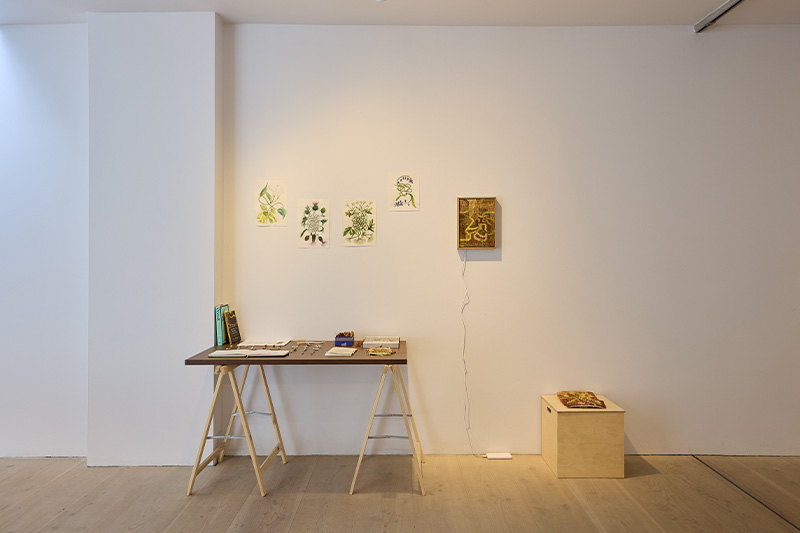
CB: For the mirror paintings, I paired plants that were closely tied to the national identity of the UK. I looked at the bull thistle, which is the national emblem of Scotland and the creeping thistle, which is an invasive plant from North America and mirrored those two.
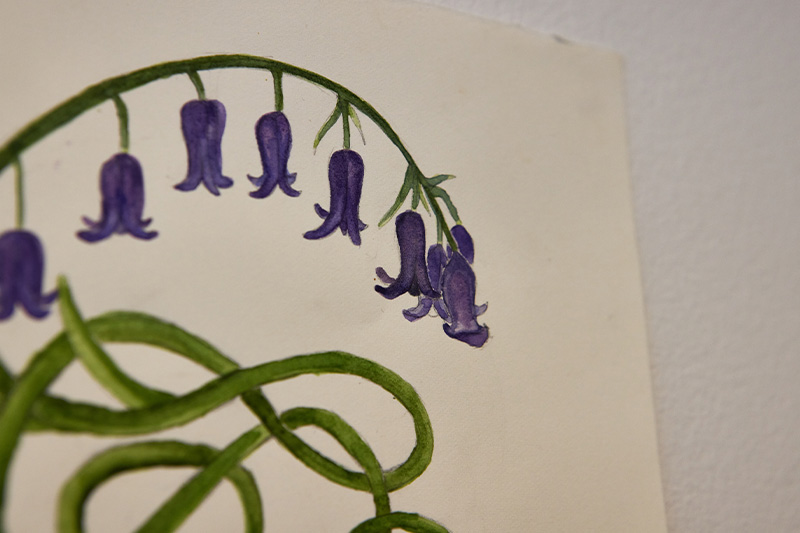
I was also fascinated by the English Blue Bell, which was slowly being replaced by the hybrid of Spanish and English Blue Bell. That is a very existential subject in botany – if the British no longer have this flower that has been such an emblem of Englishness, then who are they? I read about this “Battle of the Bluebells” even though a recent study reveals that it’s unfounded (Royal Botanic Gardens Edinburgh).
Another symbol came while doing research at the Pitt Rivers Museum where I found that some of the first charms against the evil eye were in the shape of the rue root. A lot of roots have been used in medical and magical practices, as the scientific and the occult have long evolved by side. The root became a symbol of wellness and protection and entered into this material tradition of jewelry and Talisman making.
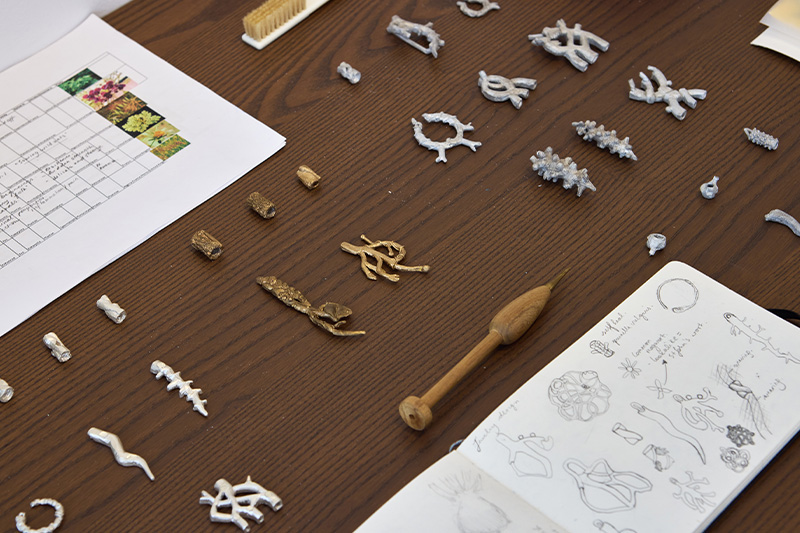
The root is also this symbol of finding home in a place. The magical relationship to plants is such a powerful tradition in the UK, notably the pre-Christian Gaelic and Celtic traditions that have a more entangled relationship to the natural world. This was really interesting to look at because entanglement is a common thread in Indigenous religious and sacred practices around the world, not to mention weaving (or knot-making) as the embodiment of this. There has always been this relationship between land, belief and material.
It’s in the traditional bastions of Christianity, or many other monotheistic religions, that have nurtured a more distant relationship to nature. There are exceptions, like Kabbalah for example, and other mystical traditions, that tap into a relationship to the natural world as a symbol of interconnectedness, and look outside of these dualities and separations. Body and soul are no longer separate. Nature and culture are no longer separate. To break down these boundaries, it’s important to look at traditions that precede this. In the West, time is measured according to Jesus Christ. European history is so centered on this timeline related to the dawn of Christianity, even though there’s a rich tradition of interconnectedness that celebrates the hybrid and ambiguous across Europe as well.
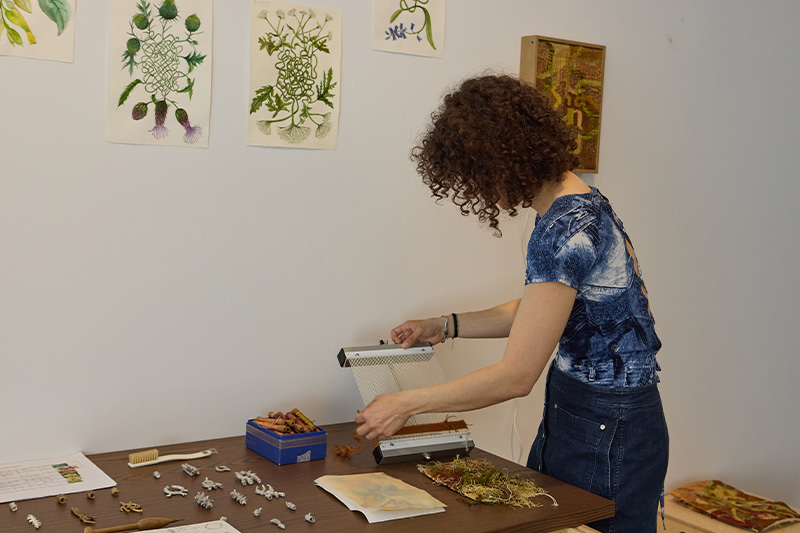
MB: On this idea of rootedness that you just mentioned, when I came for a studio visit a few weeks ago, you shared that for you the backs of the tapestries, with their hanging threads and interconnections resemble a root system, an entanglement or rhizome. Connecting these wider questions and timelines you’ve just mentioned with the physical process of weaving, could you share how you see this rootedness in the tapestries. Is there something about weaving time and these different layers of history that you’ve just spoken about?
CB: Working with tapestry connects you to an incredibly long temporality: weaving has been around for more than 25,000 years. In a way you are a prisoner of time because there’s no real way to make it faster. Your body adapts to the gestures when you’re weaving, but you are in a different relationship to time. Interestingly, Vaucanson, the inventor of the first automated looms (before Jacquard even) came from a family of clockmakers, so in a way, a loom is a machine that marks time as material.
In traditional French tapestry, you weave from the back of the textile. You have to look through a mirror to see what is coming out of the gestures that you’re putting in, so you don’t see the direct impact of what you’re doing. Another type of mirroring!
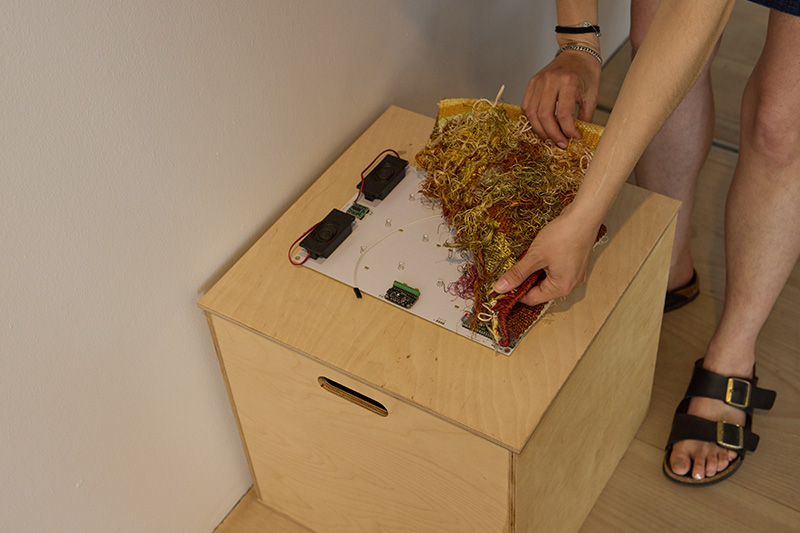
I also embed conductive yarn into the weaving, allowing the material to respond to the viewer. I’m interested in a more performative or more mirrored relationship to image because, in my family, mirroring the local culture became a way of fitting in. I have an American accent because I moved to the United States when I was seven. My body changed. My tongue changed, even in the muscles that it formed by performing the other accents that I heard. There’s this gesture of always mirroring something else, and the impossibility of creating something “original.”
This is also why, in a lot of my work, there’s language embedded within it, often in ways that are not legible. Exploring the secret embedded information within the tapestry fascinates me because there are so many layers of being that I witnessed just being from a multi-cultural background.
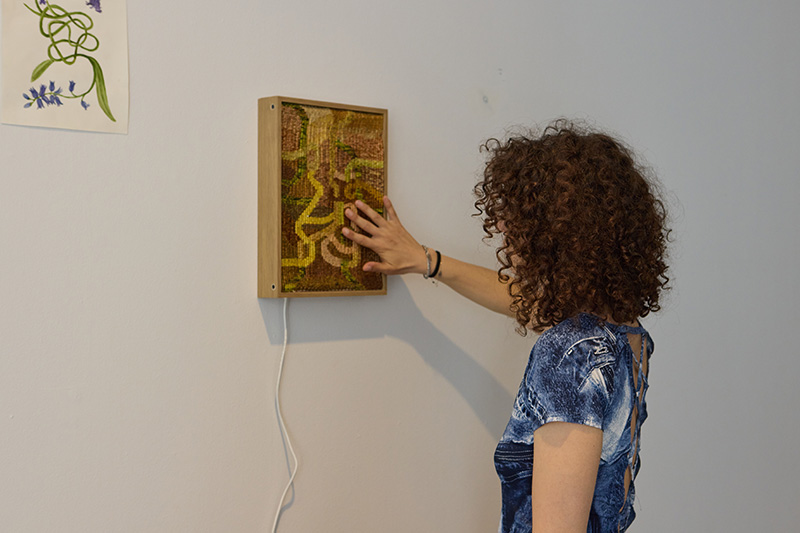
MB: I have a question around language and the relation between language and voice in your work. You invited me to play a sonic tapestry work that had sounds embedded into it, some of the threads are copper conductors. I remember being so mesmerised by this process of activating vocal sounds and tonal arrangements in specific places in the tapestry. There were visual symbols corresponding to those places. This is a question around time as well, because it’s not a linear sonic piece but an improvisation that’s assembled through everyone’s performative interaction with the tapestry.
CB: I’m always interested in the history of a material. So, for example, in the case of these silk tapestries that I inherited from the French National Tapestry Workshop, which are from the 19th century, I found myself imagining what those materials would say if they could speak.
I was always inspired by song and its relationship to the sacred or this connection with something invisible. In Judaism and other traditions, your first interaction with music is often through faith. I felt that there was something, that if I was trying to connect with the invisible or the unseen sound would be the best medium to materialise the invisible.
Of course, textile and weaving are also connected to that, because in many cultures around the world, spiritual leaders are historically taught to weave or embroider. There are traditions in the Middle East, like Tiraz textiles, of weaving or embroidering sacred texts. The overlap between text and textile runs long and deep, the word ‘text’ comes from ‘textile’, meaning ‘interlaced’ in Latin.
I work with musicians to do the sounds within the tapestries, more often with voice than instruments, so that the tapestry takes on an anthropomorphic quality. It is an interesting way to question ‘what is human?’, ‘what is non-human?’, ‘what is visible?’, ‘what is invisible?’, and how to navigate those dualities.
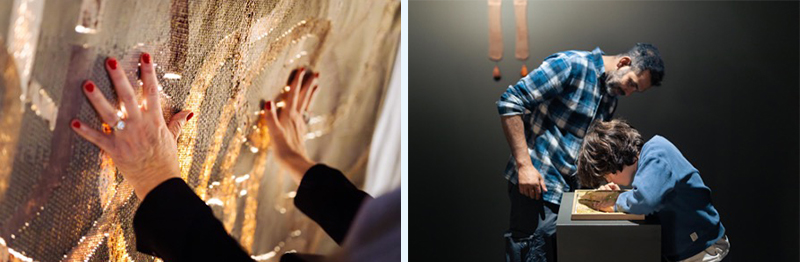
The interaction component is important in that sense because, maybe this is a little on the nose, but mentioning Karen Barad’s work and this relationship, that is the in-between (Intra-action). The work materialises in that space between the person interacting with the tapestry and the tapestry itself. There’s no absolute subject or experience; it’s constantly being determined by the person interacting with it. As you said, you can compose different sounds depending on where your hand goes. In the same way that our relationship to the natural world is so mediated, each person’s background has such an impact on how they see it.
MB: Feminist writers like Astrida Neimanis have offered powerful ways of imagining and practicing embodiment and thinking with fluidity. A question she poses that has stayed with me: ‘if non-human natures as agential express themselves in myriad ways – that is, if nature speaks for itself – what mistranslations or further colonisations are taking place as these voices are channelled by human tongues?’ How do these questions of voice, embodiment, translation and mistranslation resonate with you?
I’ve always been more drawn to the imperfection of translation than to the accuracy of representation. The interactive tapestries I weave become “interfaces” through which communication happens. Translating nature is an imperfect task, since the body is the interface with which we experience it. The body is at the heart of this work, since the symbols or motifs in the tapestries refer to what we see with our retinas, the textures are felt with our fingers, and the sounds are produced by vocal cords or recorded for human ears. The body is both the filter and, as Neimanis highlights, made of nature. I don’t see the work as representing nature, more so as representing a body and its connection to all that which has been “othered” in the quest for human exceptionalism(s). Touching the tapestry becomes a kind of remembering.
MB: You’re moving is this space of hybridity and the ‘in-between’ as you called it, also between the human and the non-human. Do you imagine your tapestries as constellations of kinship and connection then? In this line of thought, while you’ve been in London, has there been any resonance with William Morris and this quite utopian thinking of the Arts and Craft movement in relation to the potential of weaving?
CB: Well, William Morris is the person who made me want to work in craft. He advocated for reinstating the human via craft in an era of enormous mechanisation, arguing that it would feed the soul. I mean, that’s the best advertisement for craft. He also included the language of the natural world in his work, also to feed a larger mission that he had around a different way of being in the world. He was a huge socialist and believed in different ways of interacting, with more slowness and his texts, in the era of AI, have a lot of resonance. I work with technology, of course, and it’s a big part of how the work becomes interactive. But I still think the goal of the work is to tap into the physical and the material in different ways.
MB: I love this phrase, to ‘feed the soul’, this resonates with my experience of playing the tapestry. Technological experimentation was so literally embedded, but also sensorially embedded in something that was reaching far back in time in an old way of knowing and doing things, echoing these thousands of years of weaving practices.
CB: I love that. I found out recently about Avery Gordon’s work on ‘ghostly matters’ about ghosts and the ways that we sometimes remember things that we didn’t even know we knew. Humans have been touching their way through the world for centuries. We live in these very sleek existences. There’s also a way in which touching the work reignites a relationship to texture and to the physical, a reconnection to the body that can be quite healing for people.
I’m interested in people having an experience where they can just be present. Maybe they walk out with just a fun experience, or maybe they take this level of attention somewhere else. And maybe next time they’re in a field they touch the grass, or they listen to the wind blowing through it. This shift in perception and attention. Like you’re nurturing a muscle that we’ve lost.
MB: Coming back to something you hinted at throughout our conversation, you’ve mentioned personal histories of migration and movement across generations. How legible do you want this to be in the work, is it more about a shared human experience of diasporic journeys, of plants, people and other lifeforms?
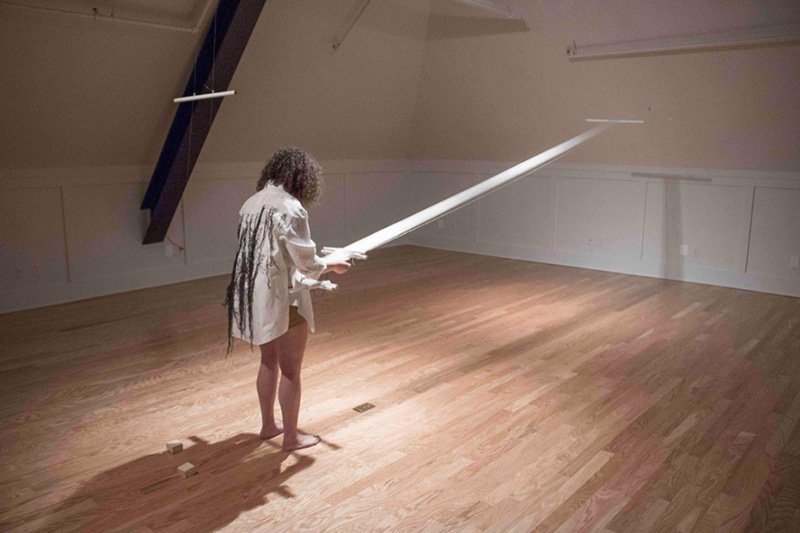
CB: I dip in and out of the personal, because I grew up in a family, originally on my dad’s side from Algeria and Morocco, and then on my mom’s side from Spain. In both cases their grandparents or their parents hardly told them about their family histories. Languages were lost. And so there’s quite a big loss of tradition there in a way that I don’t feel legitimate to represent any one of those cultures. This is also why I started focusing on the space in-between because I find that that’s where I exist more comfortably. This transient identity that, since the 90s, is now a global condition of many people living in the spaces between. I want to speak to those people, perhaps, and then find the overlaps between different cultures (there are so many). For example, the Talismans that we see in the lower Mediterranean that are in the shape of a root, they also start to resemble motifs found in a gothic illuminated manuscript, or Yemeni jewelry, but they also resemble some of the more sacred architectures in other contexts. It’s non-specific in that sense, because moving and sharing (information, motifs, craft techniques) is at the heart of how human civilisations evolve. When I do performances, for example, some have been interactive where my body is on display, and perform exactly what forgotten or invisible histories I carry, all in one body.
MB: I imagine the activations are also about how your works resonate in relation to what participants who engage with the work bring to this themselves.
CB: Totally, I sometimes find that we’re collectively losing this capacity to understand cultures that are not specifically our own, which is heartbreaking. I think people feel very easily excluded if a certain cultural narrative is not exactly their own, which is quite limiting in a way for people’s experiences. Sometimes creating these more ambiguous spaces allows an entry point for someone to have an experience or have an interpretation that they didn’t expect.
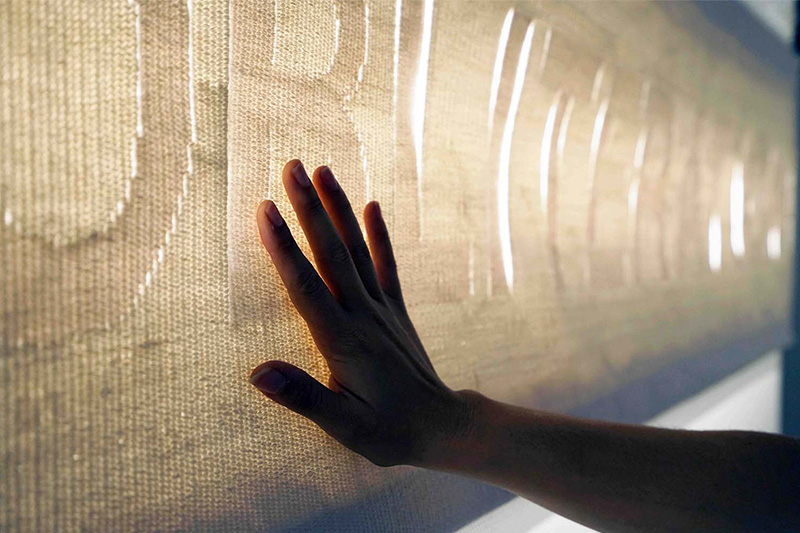
When I showed “Words Weave Worlds” in 2019 around the history of white and whiteness, I had people of European descent come to me and say ‘I didn’t know that whiteness or white could be interpreted in this way’. It was white-on-white text, and you couldn’t read any of it unless you interacted with the surface of the tapestries. People can be surprised about what they learn when their bodies become part of the work.
MB: Can you share a little about how the research you’ve done during your residency sits in relation to what’s coming next and what it’s feeding into?
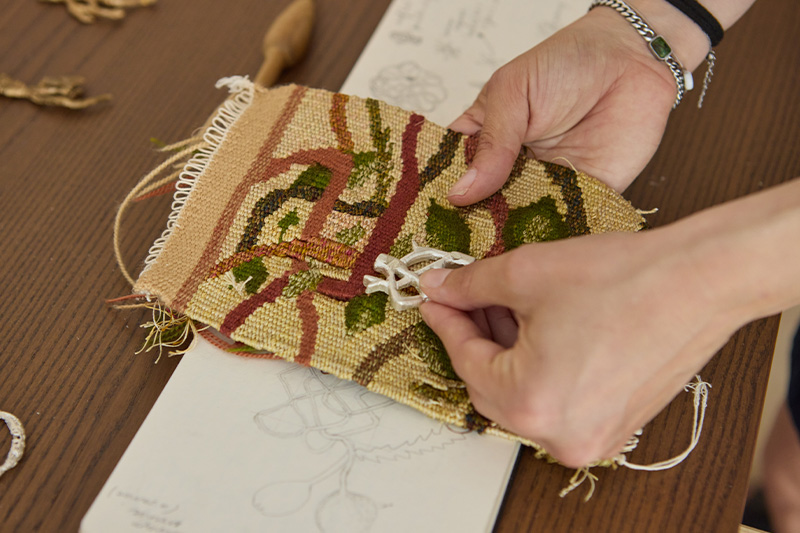
CB: I’ve loved working on botanical drawing, it’s something that I’m going to carry with me moving forward. Some of the jewellery work around these root-shaped talismans are part of a new tapestry technique that I’m working on in which those pieces will be embedded within the tapestry and then connect it to the conductive system within the tapestry. They also become activated, perhaps by touch or rubbing. This will feed a new body of work that bridges the representational. The representational will also perhaps even enter the realm of the body or the physical and allow me to incorporate the body in increasingly visible ways, whether it’s my body or the botanical bodies that I’m inspired by or interested in.
Suggested Readings:
David Abram, The Spell of the Sensuous
James Bridle, Ways of Being, Animals, Plants and Machines: The Search for a Planetary Intelligence
Karen Barad, Meeting the Universe Half Way
Avery Gordon, Ghostly Matters
Astrida Neimanis, Bodies of Water & ‘No Representation without colonisation? (Or Nature Represents Itself)
Banu Subrahmanian, Botany of Empire
Royal Botanic Garden Edinburgh, Sex in the country is better for British bluebells
Marleen Boschen is a curator, lecturer, and artist whose practice explores the intersections of art and ecology. Since 2023, she has served as Adjunct Curator of Art and Ecology at the Hyundai Tate Research Centre: Transnational. She is also a postdoctoral fellow at the Royal Botanic Gardens, Kew, where her project, Future Ecologies of Art, investigates botanical organisations as sites of artistic research. Together with Elena Agudio, she co-curated Testing Grounds / Seeding Worlds, an artistic programme at the garden of Villa Romana, Florence, exploring cultivation, migration, and agroecological learning.
Chloe Bensahel was a resident for Delfina Foundation’s inaugural Making and Materiality thematic season. Her residency was supported by Yukiko Ito.